Machine Learning, AI & Agents

Paper explainers, model architectures, agent systems, and the mechanics behind modern AI

How Reasoning Models Learn to Think

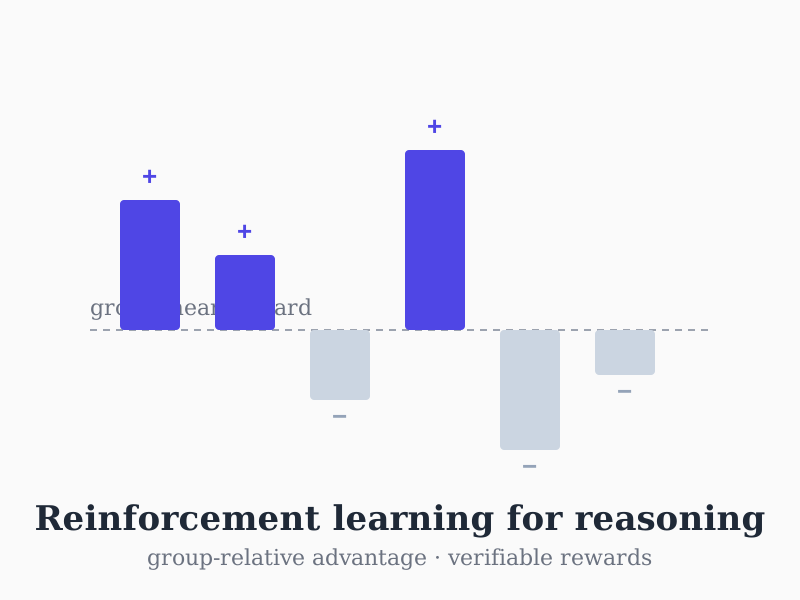
Pretraining teaches a model what to say; it does not teach it how to think through a hard problem. Reasoning models like OpenAI o1 and DeepSeek-R1 add a second training phase: reinforcement learning against rewards that can be checked mechanically, such as a math answer or a passing test suite. This post explains that recipe — the verifiable reward signal, the GRPO algorithm that makes it cheap, the behaviors that emerge, and the new scaling axis it unlocked at test time.

GLM-5.2: The Open-Weight Model That Beats GPT-5.5

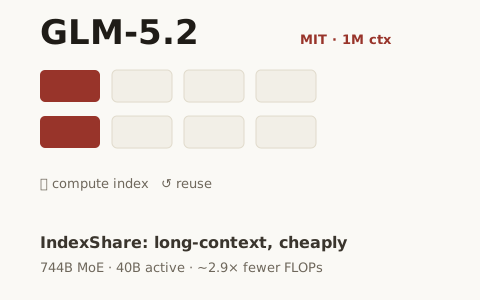
GLM-5.2 is an MIT-licensed open-weight model that extends its context window to 1M tokens and ranks as the highest open-source model on Z.ai's evaluations, beating GPT-5.5 on long-horizon coding. Its headline trick, IndexShare, reuses sparse-attention indices across groups of layers to cut per-token FLOPs by 2.9× at 1M context. This article explains the architecture, the core mechanic, the real benchmarks, and the community's reaction.

Development

Tools, workflows, and practical engineering insights

Business & Industry

Compensation, industry trends, and career strategy through data

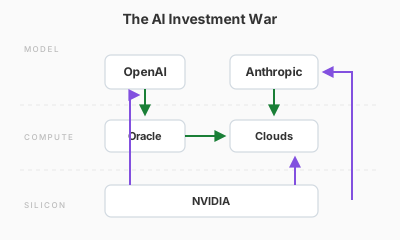
The AI Investment War

By mid-2026, the AI industry has organized itself into four layers — applications, models, compute, and silicon — stitched together by a dense web of equity stakes and hundred-billion-dollar supply contracts. The striking feature is not the size of any one deal but the circularity: a chipmaker invests in a lab, the lab pays a cloud, the cloud buys the chips. This interactive map lets you trace every major deal — click a company to see its full position in the war, or click an arrow for the terms — and the essay decodes the deal structures and asks what would tell the bulls from the bears.